February 26, 2026
Stone Center Affiliated Scholar Anna Stansbury, an assistant professor at the MIT Sloan School of Management, and Kyra Rodriguez, a Ph.D. student at UC Berkeley Haas School of Business, are the authors of “The Class Gap in Career Progression: Evidence from U.S. Academia,” part of the Stone Center Working Paper Series. The paper is forthcoming from Econometrica: The Journal of the Econometric Society. In this blog post, the authors discuss their findings.
By Anna Stansbury and Kyra Rodriguez
Gender and race have rightly become central to how researchers and organizations think about career disparities in elite occupations. But there is a glaring omission: class. Among the roughly 600 large U.S. firms whose DEI goals and reporting we reviewed in September 2024, virtually all discussed gender and race, and most discussed LGBTQ status, disability, and veteran status as well — yet only 6 percent made any mention of socio-economic background. Socio-economic or class background is similarly absent from most academic research on career progression.
Figure 1: Large U.S. companies’ DEI goals and reports ignore class background
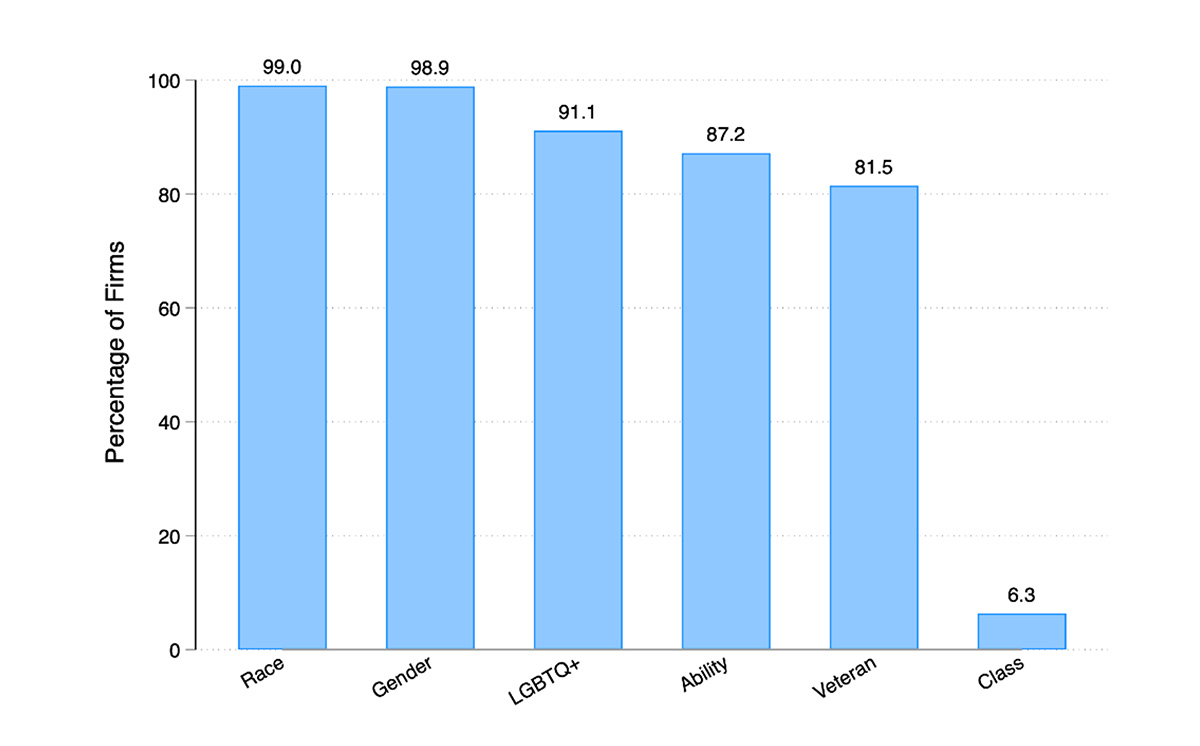
Notes: Data sourced from companies’ websites and DEI reports, scraped September 2024. Figure shows the share of large U.S. firms that have any goals, reporting on, or discussion of each of the listed groups in the context of diversity, equity, or inclusion. Sample was initially defined by all firms in any of: S&P 500, Forbes 100 largest private companies by revenue, Y Combinator top 50 companies by revenue, and TIME America top law firms with revenue >$1bn, which resulted in 708 total firms. This figure’s sample comprises only the 631 U.S. firms that publicly report on DEI. “Class” keywords include: First Generation, Socio-economic, Parental Education, Low Income, Working class, Social Class, Pell Grant.
Why this absence? There is a common assumption that — while class background matters for access to elite education — once someone gets a foot in the door of an elite college or an elite job, its effects are “washed out.” A quote from one professor in our survey of U.S. faculty members in Spring 2025 epitomizes this belief: “Education is a great equalizer. SES is an important element in access to higher education, but conditional on access, most differences wash out.”
This assumption, however, is wrong. Our recent paper uses U.S. tenure-track academia as a detailed case study of elite professions and finds a large class gap in career progression — when comparing people who did their Ph.D.s in the same program but came from different socio-economic backgrounds.
Setting and approach
Our data are from the National Science Foundation’s (NSF) Survey of Doctorate Recipients (1993–2021), which is a representative survey of tens of thousands of U.S. Ph.D. recipients in STEM and the social sciences, linked to the NSF’s Survey of Earned Doctorates and to bibliometric data from the Web of Science. To proxy for socio-economic background, we use highest level of parental education, comparing four groups: first-generation college graduates, those with at least one parent with a bachelor’s degree, those with at least one parent with a non-Ph.D. graduate degree (e.g., JD, MD, M.B.A.), and those with at least one parent with a Ph.D. Our core “class gap” compares the first and third groups — we don’t focus on those with parents with Ph.D.s, because having a parent with a Ph.D. likely confers academia-specific advantages, beyond the role of the generalized socio-economic advantage that comes from having parents and family members with higher incomes or education levels.
Crucially, all of our estimates condition on Ph.D. institution, Ph.D. field, and cohort fixed effects, alongside controls for race, gender, and birth country. This means that all comparisons are — approximately — comparing people of the same race, gender, and country of origin, who did the same Ph.D. program around the same time but had different parental education levels. Doing so allows us to empirically show that any socio-economic differences we find cannot be explained away by factors such as Ph.D. background.
There is a large class gap in career progression in U.S. tenure-track academia
Our results show that first-generation college graduates are less likely to end up tenured at high-ranked institutions compared to their former Ph.D. classmates from more advantaged backgrounds. Specifically, conditional on Ph.D. program attended, first-generation college graduates are 10 percent less likely to end up tenured at a highly research-intensive (R1) university, and are tenured at institutions ranked 11 percent lower, than their former Ph.D. classmates with a parent holding a non-Ph.D. graduate degree. And this is not simply the result of first-gen college grads trading prestige for other benefits: first-gen college grads also earn 3 percent less and report 5 percent lower job satisfaction than their former Ph.D. classmates with a parent with a non-Ph.D. graduate degree.
Figure 2: First-generation college graduates are less likely to end up tenured at prestigious institutions, earn less, and are less satisfied with their jobs than their former Ph.D. classmates from more privileged backgrounds.
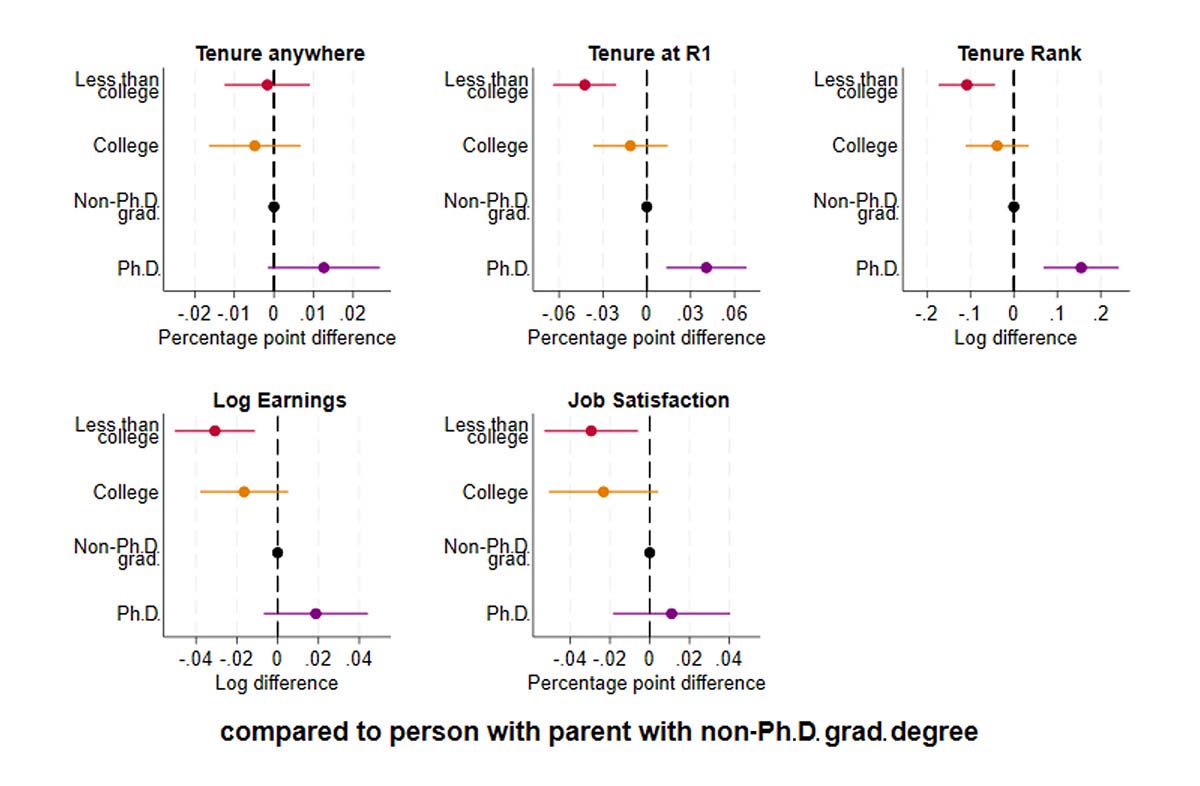
Note: Figure shows average differences in academic career outcomes by highest level of parental education, compared to someone with a parent with a non-Ph.D. graduate degree (omitted category). These estimates implicitly compare people from the same Ph.D. program, and with the same race and gender (regressions include fixed effects for Ph.D. field, Ph.D. institution, Ph.D. year, survey year, race/ethnicity, birth country, and gender). Plots show estimates and 95% confidence intervals. Data are from U.S. National Science Foundation’s Survey of Doctorate Recipients, 1993–2021.
A finding that surprised us: the class gap exists entirely on the intensive margin. There is no class gap in whether someone ends up in tenure-track academia at all: the gap is all in where they end up. Academics from less advantaged backgrounds are not being disproportionately pushed out of academia, but they are ending up in less prestigious positions within it.
Moreover, the class gap emerges at two key career junctures: on the tenure-track job market (conditional on Ph.D. program) and at the point of the tenure decision itself (conditional on tenure-track institution). On the tenure-track job market, first-gen college graduates are less likely to end up in a tenure-track job at a high-ranked or research intensive university than their Ph.D. classmates from more advantaged backgrounds. And at the tenure stage, first-gen college graduates are 6.6 percentage points — roughly 9 percent — less likely to receive tenure than their peers working at the same institution who have a parent with a non-Ph.D. graduate degree.
Research productivity cannot explain (most of) the class gap
What explains this gap? We investigated three sets of mechanisms. The first is differential research productivity: it is possible that first-gen college grads end up tenured at less research-intensive, lower-ranked institutions because they publish less or lower-quality research. Using the Web of Science data, we control for a comprehensive set of measures — publications, first- and last-authored papers, citations, journal impact factors, NSF awards, and “hit” publications — all interacted with field to account for field-specific publishing norms. These detailed research controls close at most two-fifths of the class gap in tenure institution rank, and less than one-fifth of the gap in the rate of getting tenure.
More specifically, while differential research output plays some role, first-gen academics are still substantially “underplaced” — tenured at lower-ranked institutions than their publication records would predict.
Figure 3: Academics from privileged backgrounds are more likely to be “overplaced”: tenured at institutions that are higher-ranked than their research record would predict.
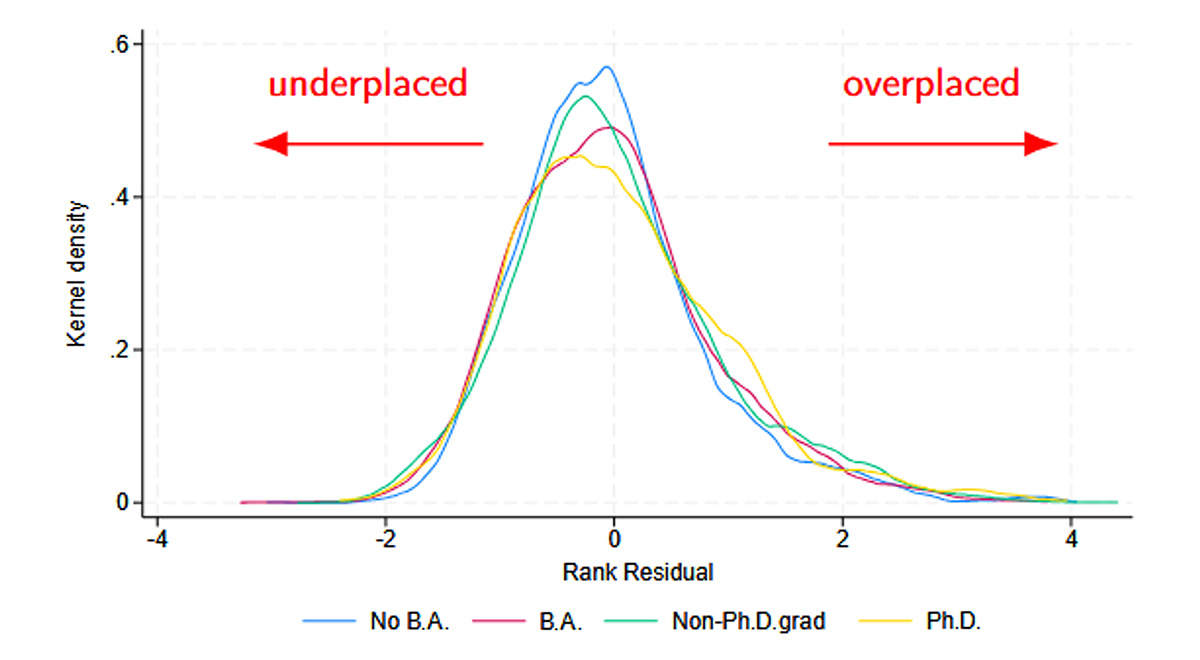
Note: Figure shows the distribution of tenured academics in our data by parental education, based on whether they are tenured at an institution which is higher- or lower-ranked than would be predicted by their research output and Ph.D. institution. (Specifically, it shows the residuals, by parental education, from a regression predicting log rank of tenure institution with research output and fixed effects for Ph.D. field, Ph.D. institution, race/ethnicity, gender, birth country, and time). Data are from U.S. National Science Foundation’s Survey of Doctorate Recipients, 1993–2021.
Preferences and constraints also don’t seem to play a role
Perhaps the class gap is simply a result of different choices: first-gen academics may choose to work at lower-ranked institutions to be closer to family, earn higher pay, or work somewhere with a stronger social mission, for example. But we find no evidence for any of these channels. The class gap is unchanged when controlling for distance from home or student debt; it is similar for those with and without children; and there is no class gap in stated preferences for job location, pay, or institutional mission.
Social and cultural capital differences are likely drivers
With research productivity and preferences unable to explain most of the class gap, what might? We think our empirical and qualitative evidence points to differences in social and cultural capital as being the important mechanisms. Following Bourdieu, we define social capital as relationships which can provide useful professional resources, advantages, and knowledge in academia; and define cultural capital as the tastes, ideas, habits, and behaviors that confer status or recognition in academia. Social and cultural capital might matter for having better mentors, more opportunities to get grants or feedback on work, professional opportunities, and professional recognition. These in turn may affect success in career progression.
We find several pieces of supporting evidence. First-gen academics have fewer coauthors, and their coauthors are less well-published than you would predict given these academics’ other characteristics. We also find significant homophily by socio-economic background: first-gen academics are more likely to coauthor with other first-gen academics. This is reminiscent of other research on women and racial minorities — suggesting barriers exist to forming professional relationships between more- and less-advantaged colleagues. Conditional on detailed research controls, we also find that first-gen academics are also less likely to receive NSF awards and their publications receive fewer citations — suggestive of reduced professional recognition.
There is only so much nuance that you can get from large-scale quantitative data. So, we supplemented our analysis with a survey of over 2,000 U.S. STEM and social science faculty members, which we ran in Spring 2025. In this survey, we asked open-ended questions about how individuals’ socio-economic background has or has not affected their career.
When discussing post-Ph.D. careers, cultural capital emerged as an overwhelming theme. Respondents described an academic “dress code and speaking code that is difficult to learn unless you are raised with it,” and noted how cultural knowledge — international travel, literature, classical music — greased the wheels of networking and professional recognition. One ecologist wrote, “My speech was colloquial. I did not know how to verbally talk academic-ese.” One first-gen industrial engineer observed that not knowing “proper social graces” reduced his “ability to create useful connections.”
Social capital was another dominant theme. First-gen academics described having fewer pre-existing relationships with academics and finding it harder to build new mentorship networks. The consequence was difficulty navigating what many called the “hidden curriculum” of academia — the unwritten knowledge about how to publish, apply for awards, negotiate, and advance. As one mathematician put it: “Pursuing an academic career as someone from a low-income background is like trying to find your way through a dark room by feeling along the walls — while your peers navigate the same space with a bright light.”
Class gaps rival race and gender gaps — but work differently
Strikingly, across most of our post-Ph.D. outcomes, the class gap is as large as or larger than analogous gender or racial gaps. But these gaps have different structures. The gender gap in academia arises primarily on the extensive margin (women leaving academia — the “leaky pipeline”), while the class gap is entirely on the intensive margin (staying in academia at similar rates, but at less prestigious institutions). And while gender and some racial gaps in tenure outcomes are substantially closed by research productivity controls, the class gap is not. This underscores that class gaps require their own analysis and, likely, their own policy responses.
Beyond academia
Is this just a problem of the ivory tower? No. Academia is a useful case study — it has common, quantifiable measures of employer quality, promotion, and productivity — but we think these findings apply more generally. We can test this with our data among Ph.D.s who work in industry. Indeed, in industry we also find a class gap in earnings, job satisfaction, and the probability of becoming a manager (conditional on Ph.D. program attended) — and the earnings gap widens substantially over the career. This means that academia is not unique: a class gap in career progression likely exists across many elite occupations.
Figure 4: A class gap in career progression also exists for Ph.D.s in industry — not just in academia

Note: Figure shows the average class gap in earnings (on the left – log can be roughly interpreted as a percent difference) and in the probability of becoming a manager, between first-generation college graduates and people with a parent with a non-Ph.D. graduate degree, conditional on fixed effects for Ph.D. field, Ph.D. institution, time, gender, race/ethnicity, and birth country. Gaps are shown separately by 5-year buckets since Ph.D. completion. Data are from U.S. National Science Foundation’s Survey of Doctorate Recipients, 1993–2021.
The challenge is that most organizations do not collect data on employees’ socio-economic backgrounds, making the gap nearly impossible to study — and invisible to the institutions that need to address it.
Our findings suggest that researchers and practitioners should consider socio-economic background alongside race and gender as an important axis of advantage in elite career progression. Studying it — and ultimately addressing it — requires, first, that we start paying attention to it and measuring it.
Read More: