April 28, 2026
Last year, Stone Center Senior Scholar Branko Milanovic published The Great Global Transformation: National Market Liberalism in a Multipolar World in the U.K. It is now available in the U.S. as The Great Global Transformation: The United States, China, and the Remaking of the World Economic Order. The book analyzes how the greatest changes in global incomes — the creation of a new upper class in China, and the decline of the middle class in the U.S. — since the Industrial Revolution are likely to influence the global economy in the next century.
Milanovic is the author of award-winning and landmark books such as Visions of Inequality, Capitalism, Alone, and Global Inequality, as well as last year’s collection of essays, The World Under Capitalism: Observations on Economics, Politics, History, and Culture.
On May 6, the Stone Center and Graduate Center will host a hybrid event on Milanovic’s new book. In-person tickets are no longer available, but you can register for the livestream. A video of the event will be posted later on the Graduate Center’s YouTube Channel.
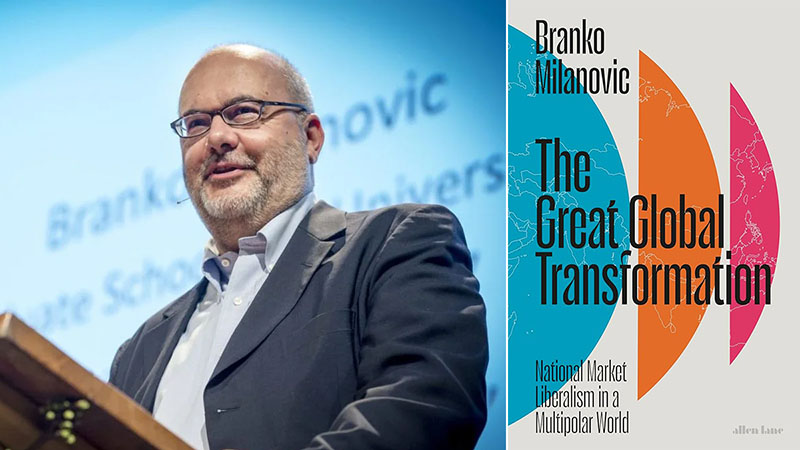
The following is an excerpt from The Great Global Transformation.
By Branko Milanovic
One day, in the spring or summer of 1989, at lunchtime, I went to Kramer’s Bookstore on I Street in Washington DC. There I ran into Jeffrey Sachs and David Lipton, two American economists whom I had known from their involvement in the Polish economic reforms, long before the change of government in June 1989. They were carrying a pile of books on Eastern Europe and the history of communism that they had just bought, and I mentioned to Jeff that my book Liberalization and Entrepreneurship had been published only a couple of months ago. He asked me whether a copy was available in the bookstore. I checked and found one. Jeff bought it. It was then up to me to write a dedication. I wrote, “To Jeff who is trying to save socialism (despite itself).” The part between the brackets was supposed to be cute, and to refer to the Communist blockheads who were undermining all efforts at reform in the region. But the part before the brackets was very genuine. Jeff looked up at me in some bewilderment: “But I am trying to bury socialism, not to save it,” he exclaimed. I gave him some lame explanation, probably mentioning socialist market economy or something similar — there was no time to say more: Jeff was juggling with difficulty a dozen books in his hands.
But my thinking then went as follows. The mid- to late 1980s was a period of rising Reaganism and Thatcherism in the West (only later known under the umbrella framework of “neoliberalism”) and sharp crisis of growth in socialist economies. Their decline began in most cases with inability to repay foreign loans, incurred in hard currencies after the twin oil shocks of the 1970s. This is the often-forgotten background to the rise of the Solidarity movement in Poland, centrifugal forces in Yugoslavia, brutal austerity in Romania, the slowdown of goulash socialism in Hungary, and East Germany’s begging for Soviet and West German money.
I saw the socialist crisis as a perfect analogue to the 1929–32 Great Depression in capitalist countries. The Depression was overcome thanks to Keynesian policies. What Keynesianism did was introduce a dose of statism in an otherwise free-market economy that simply could not, on its own, get out of the Depression. Thus, capitalism was saved thanks to what many regarded as proto-socialist policies of government spending, unemployment benefits, public works and the nationalization of private companies. By analogy, I reasoned in 1989, the grave crisis of socialist economies had to be solved through the introduction of doses of capitalism: a greater role of the market, a more incentivized wage structure, liberalization of the small and medium sector for private companies, greater independence in decision-making for state-owned enterprises and paring down of central planning. It seemed to me perfectly clear that the way out of the socialist crisis was more capitalism — yet, as in the analogous case of the Great Depression — without the abandonment of the main socialist model. Just as capitalist economies did not cease to be capitalist when a greater role of the state was introduced, socialist economies, I thought then, would not cease to be socialist if the private sector played a much greater role than before.
Indeed, in the book that Jeff bought, I developed this argument, even before the socialist crisis became obvious, by among other things showing the data on the size of the private and state sectors in various economies. Capitalist economies ranged from having less than 5 per cent of Gross Domestic Product (GDP) produced in the public sector to having more than 20 per cent; socialist economies ranged from almost 100 per cent of GDP produced by the state sector to only 70 per cent. I argued: why could not the percentage of the state sector in socialist economies be reduced to a range from (say) 50 to 70 per cent without changing the fundamental nature of socialism? Eventually, the two systems may still be recognizably “socialist” and “capitalist” in ideology, but in reality they would both be “mixed” systems with relatively small differences between them. Instead of studying varieties of capitalism as branches of only one system, we would then be studying a much richer set of economies that combined, in various proportions, the market and the state. System convergence would “solve” the ideological dispute between them and make world peace more tenable. It seemed to me a win-win proposition. This was my thinking underlying the book and its dedication.
But reality went the other way. 1989 was an important year on the road to total domination of neoliberal economics across the world. Reagan’s economic policies were continued by his Republican successor, George H. W. Bush, and a few years later consolidated by the Democrat Bill Clinton. Margaret Thatcher was on her way to becoming the longest-serving UK Prime Minister in modern history. Reagan’s and Thatcher’s anti-union stance, deregulation, privatization of infrastructure and housing, and lower tax rates for capital owners and the rich, all hallmarks of policies that aimed to refashion the New Deal order and reduce the welfare state, continued unabated. Moreover, such policies expanded geographically to include no longer only the West and Japan. Between 1989 and 1992, all formerly communist economies folded and flipped to the other side: some went from 100 per cent public to 100 per cent private ownership. They did not go “mixed” as I imagined. Most moved towards a Thatcherite system where the public sector (or the government) had no business in the production of anything, not even in infrastructure, and hopefully, it was thought, not much role in spending either. Of course, such extreme precepts were impossible to implement for any length of time and “transition” economies still ended up keeping an important role for the state, especially so in Central Europe. Nevertheless, all of them were unmistakably capitalist and neoliberal.
Learn More: